rctopo
| author: | Stanislav Stoupin |
|---|---|
| email: | <sstoupin@gmail.com> |
x-ray rocking curve topography program
SYNOPSIS
rctopo [options] filename1 filename2 ... filenameN
DESCRIPTION
A program to process a sequence of topographs collected at different angles on the rocking curve of a crystal to generate maps of the rocking curve parameters. Supported area detector file formats: HDF4 (.hdf), HDF5 (.h5), a variety of image formats (PNG, TIFF, JPG)
OPTIONS
For a brief summary run:
rctopo -h
| -v, –version: | show program’s version |
|---|---|
| -h, –help: | |
| show summary of options | |
| -o F, –output=F: | |
| write calculated results to file F (default to stdout); also, generates output 1pix_total.dat showing the rocking curve from the central pixel and the total rocking curve | |
| -w D, –output=D: | |
| write slice data to file D (default: do not write) | |
| -t T, –threshold=T: | |
| threshold for data processing to reject “weak” rocking curves to define crystal boundaries (default T=1.05) | |
| -b bkg, –background=bkg: | |
| user defined background (dark current) of the area detector (default value is estimated from the rocking curve tails) | |
| -r STRING, –range=STRING: | |
| xy-range for display and analysis (STRING=’x1 x2 y1 y2’, where x1,x2,y1,y2 are in units of [mm]) | |
| -x CONST, –xslice=CONST: | |
| slice and plot distributions at a fixed coordinate X = CONST | |
| -y CONST, –yslice=CONST: | |
| slice and plot distributions at a fixed coordinate Y = CONST | |
| -f CONST, –factor=CONST: | |
| scale colormap range on topographs by CONST*FWHM_av, where FWHM_av is the average FWHM | |
| -m CONST, –magnify=CONST: | |
| shrink range on the colormaps by factor CONST; applies only to the colormaps which represent characteristic width of the rocking curve width (FWHM and STDEV) | |
| -n STRING, –name=STRING: | |
| include sample name STRING in the figure title | |
| -d CONST, –deglitch=CONST: | |
| deglitch rocking curve data with CONST as a threshold parameter (e.g., CONST=1.1) (default - no deglitching) | |
| -g, –gaussian: | |
| perform Gaussian curve fitting (smoothes noisy images) | |
| -s, –transpose: | |
| transpose image array for plotting | |
| -u uname, –units=uname: | |
| assign the original angular units (uname): deg, arcsec or urad (default - deg) | |
| -p, –publish: | generate additional figures with publication quality (requires a separate figures.py script) |
| -c, –conduct: | process forward diffraction data |
| -i, –instrument: | |
| read the detector and the image analysis parameters from an instrument file ccd.py | |
| -z CONST, –integrate=CONST: | |
| integrate reflectivity and normalize by the theoretical angular acceptance for perfect crystal (CONST); specific cases: z = 0 - no integration (default), z = -1 - integrate and normalize by the maximum value | |
| -e SPECSCAN, –external=SPECSCAN: | |
| read angular steps from the first column of a SPEC scan | |
GRAPHICAL OUTPUT
By default the program generates two figures. Figure 1 shows several topographs of the following rocking curve parameters.
reflectivity (normalized peak reflectivity by default)
FWHM (curve width calculated as full width at half maximum)
COM (rocking curve peak position calculated as center of mass or the first moment of the intensity-angular distribution)
left slope (peak position of the left slope of the curve)
right slope (peak position of the right slope of the curve)
mid-point (peak position as average of the left and the right slope positions)
STDEV (standard deviation of the intensity around the mean value or the second moment of the intensity-angular distribution)
Figure 1 also displays simple statistical parameters calculated across the entire 2D region as seen on the topographs. These parameters correspond to the mean value, standard deviation and the peak-to-valley variation. In addition, parameters of the total rocking curve (averaged across the region) are displayed below.
Figure 2 shows the rocking curve of the central pixel in the analyzed region, a Gaussian fit to this curve and the total rocking curve for comparison.
EXAMPLES/TUTORIALS
I. Sequential topography using HDF4 images
This archive below contains a set of hdf images of a diamond 111 crystal plate (one image per file) collected at different angles on the rocking curve In this example a Cu \(K_{\alpha}\) rotating anode x-ray source was used. The beam was collimated using a strongly asymmetric Si 220 reflection.
to perform quick evaluation:
rctopo -s -u deg *hdf
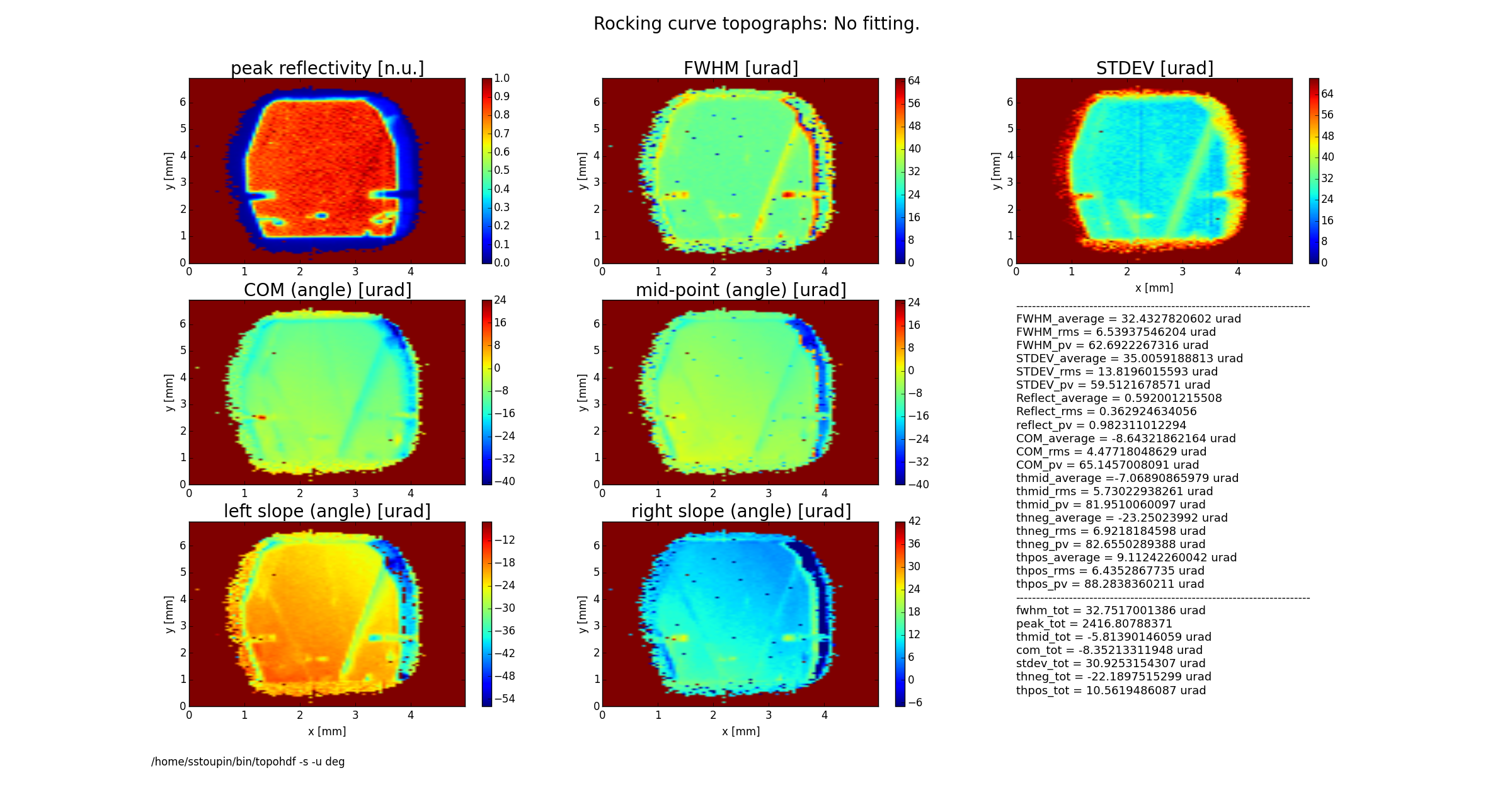
Fig. 1 Rocking curve topographs
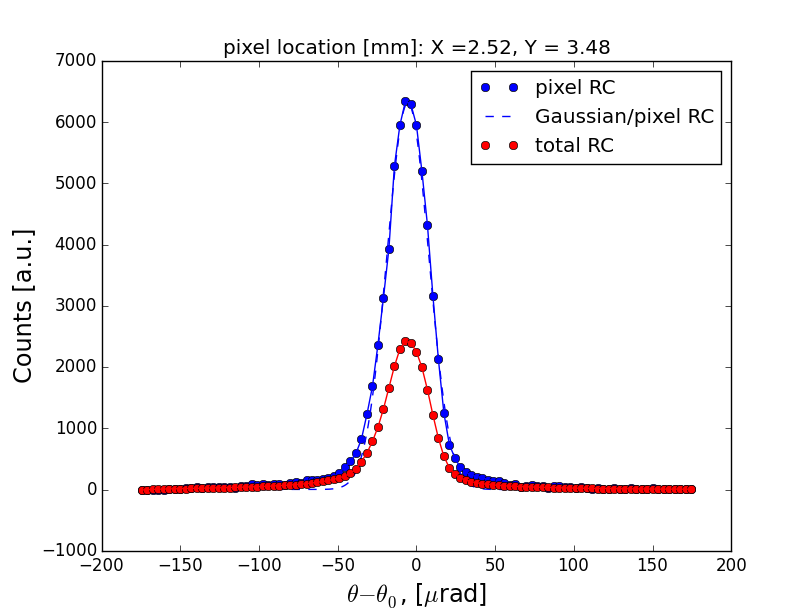
Fig. 2 Rocking curves
to better define crystal boundary (threshold for analysis), to obtain a smooth image (Gaussian fitting for each pixel), and to display the name of the sample in the figure title:
rctopo -t 1.1 -g -s -u deg -n diamond1 *hdf
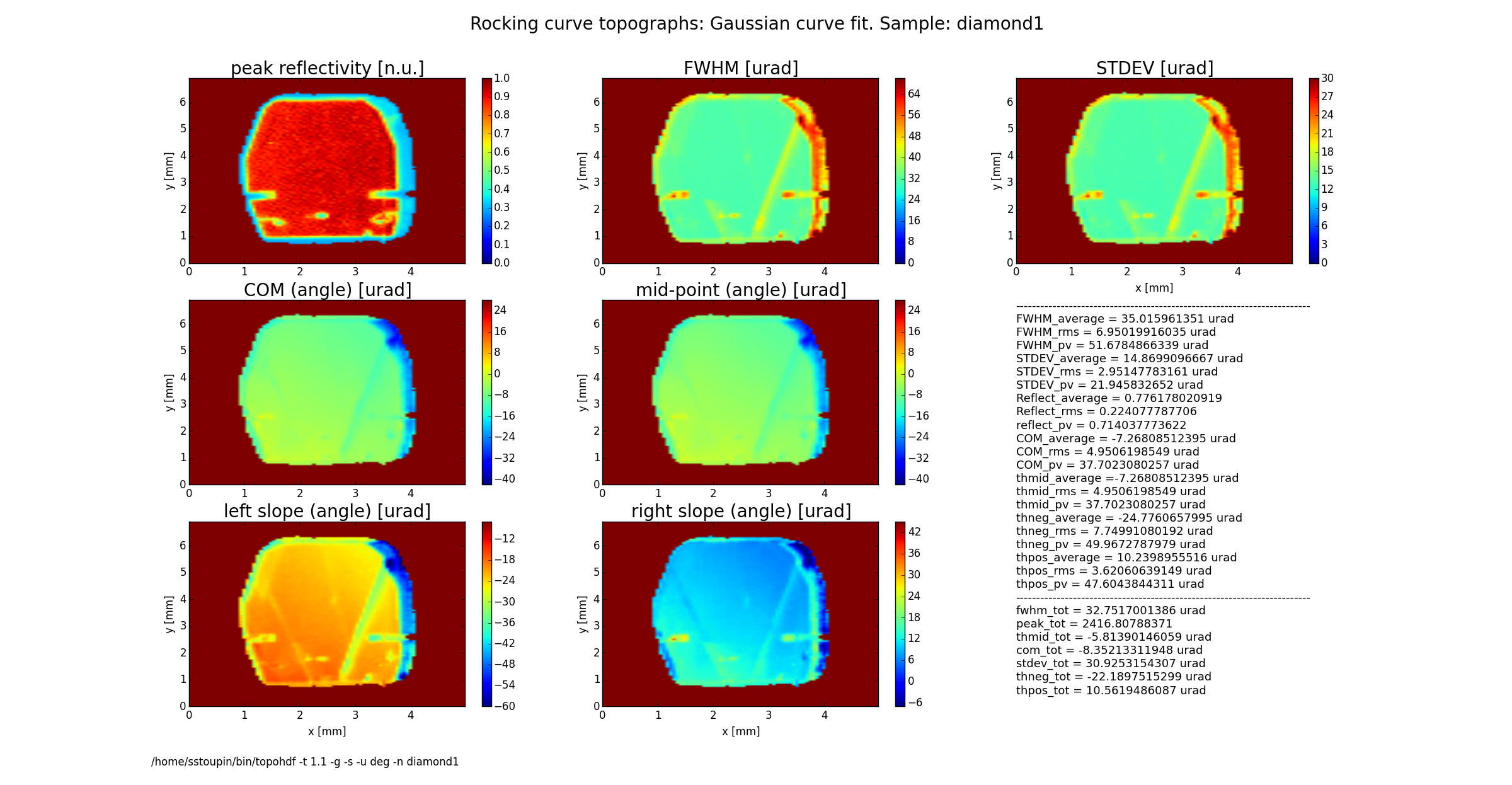
Fig. 1 Rocking curve topographs
to select a region (the program assumes mm) and to perform statistical analysis and visualization over this region:
rctopo -r '1.5 3.5 4 6' -t 1.1 -g -s -u deg -n diamond1 *hdf
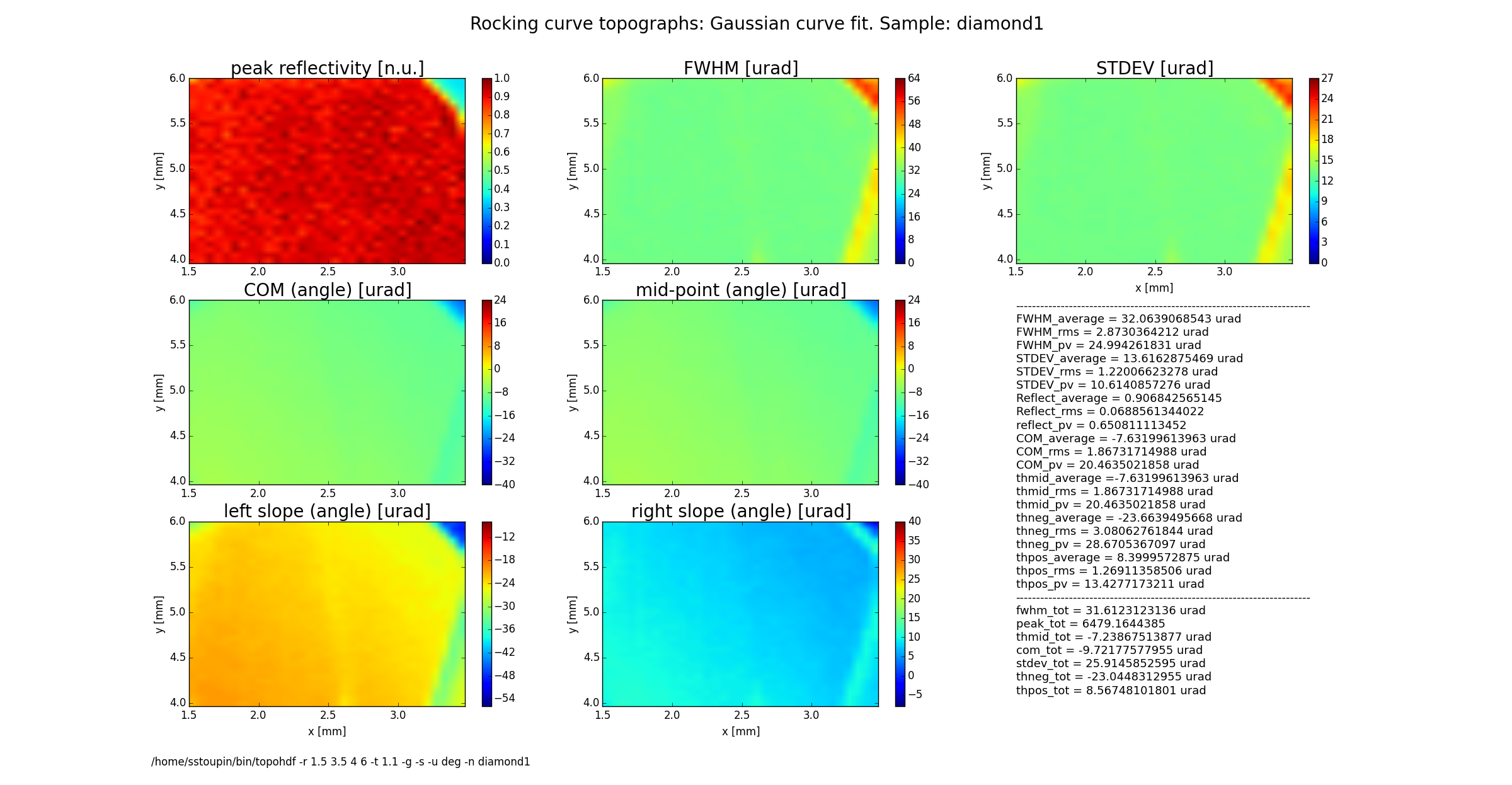
Fig. 1 Rocking curve topographs
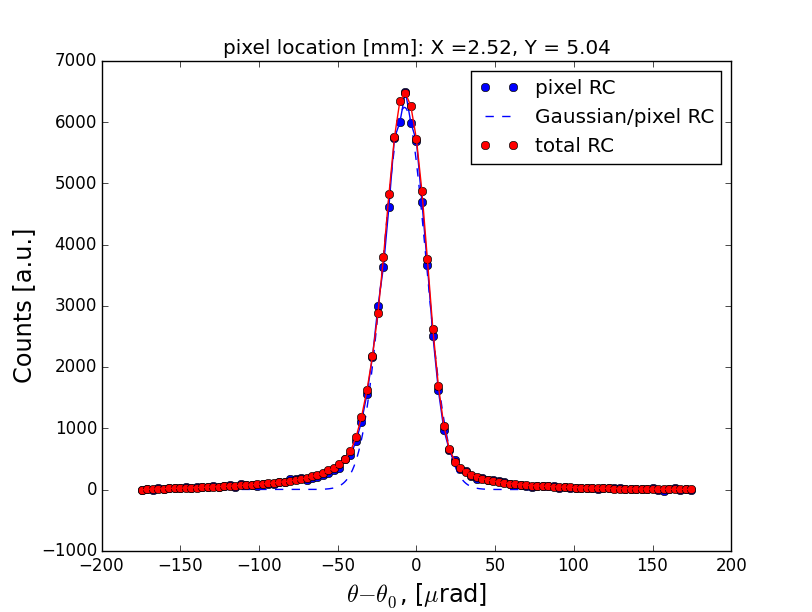
Fig. 2 Rocking curves
II. Sequential topography using HDF5 images and an instrument file
The archive below contains a sequence of images embedded into h5 files (one file per image) of a diamond 111 crystal plate. The source was a bending magnet synchrotron beamline with a double-crystal Si (111) monochromator tuned to a photon energy of 8.05 keV. A strongly asymmetric Si (220) collimating crystal was used.
C111-1.zip
The area detector PIXIS 1024F has a pixel size of 13x13 um^2. These parameters are described in the instrument file below.
Note, that the instrument file includes paths within the h5 file for the image array, theta and chi angles. To perform faster data processing rebinning is enabled using the rebinning factor rbin=4. Parameters tot_range and dyn_range define the upper limit of the dynamic range (a factor to the background level bkg0). These can be used to reject “hot” pixels.
To process the seqence of images using the instrument file (-i option):
rctopo -p -r '1 12.5 4.8 8.8' -t 20 -f 0.1 -s -i -u urad
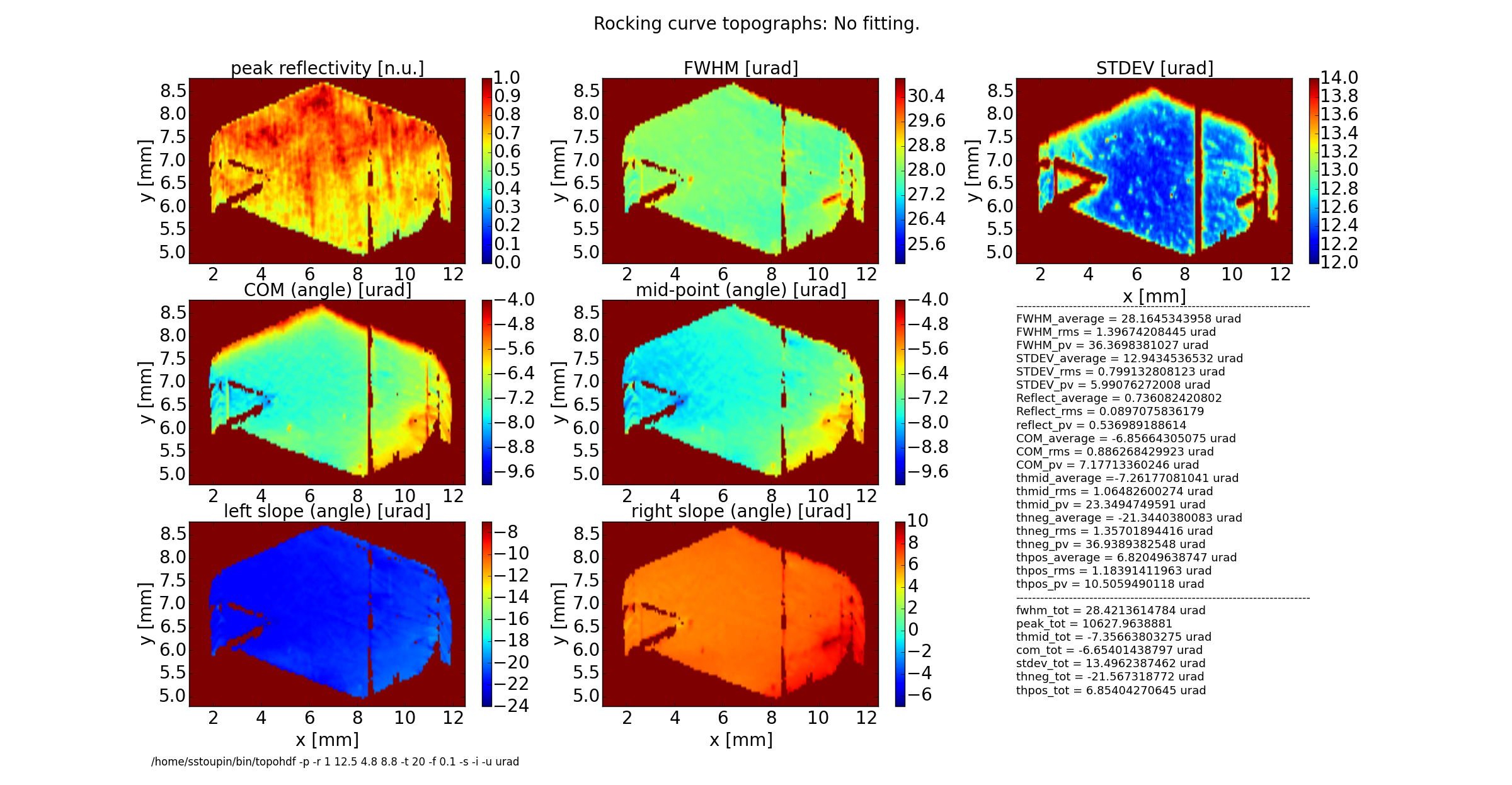
Fig. 1 Rocking curve topographs
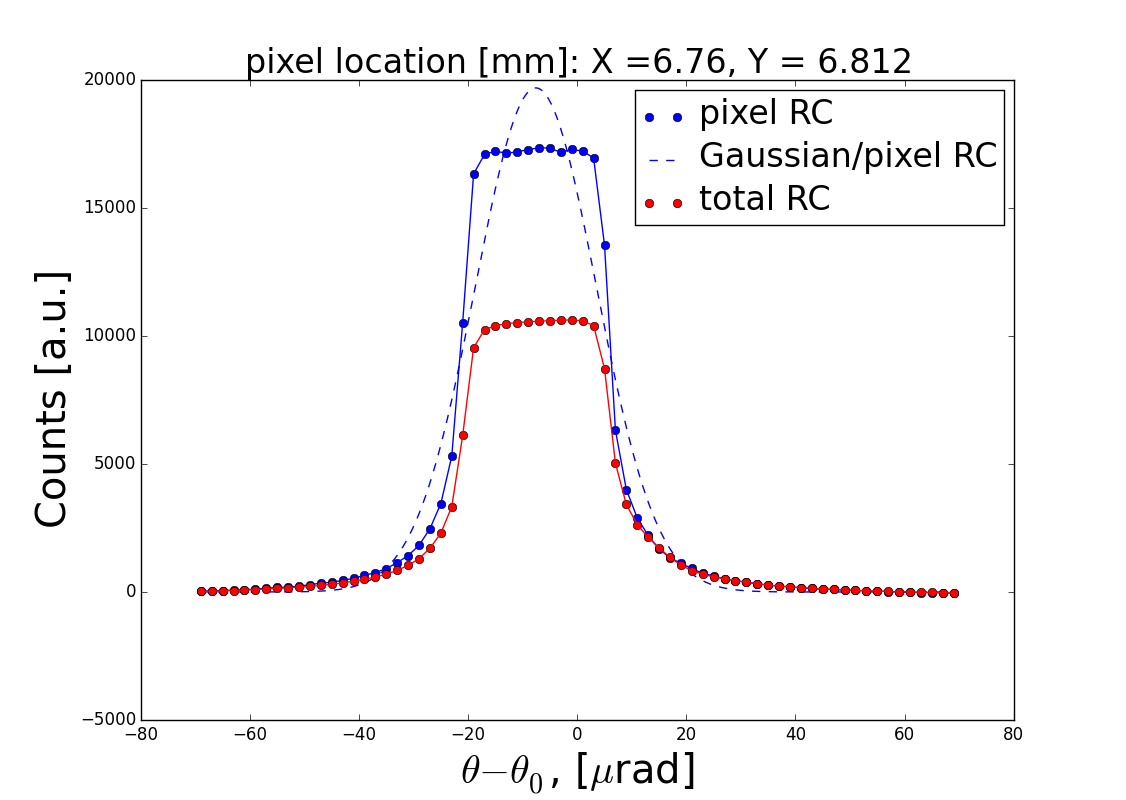
Fig. 2 Rocking curves
Here, option -p calls for a script (placed along with ccd.py in the current data folder):
where an additional figure is generated having customized axes, titles, subplots, etc. This custom script written using matplotlib commands and parameters in principle can yield a publication-quality figure.
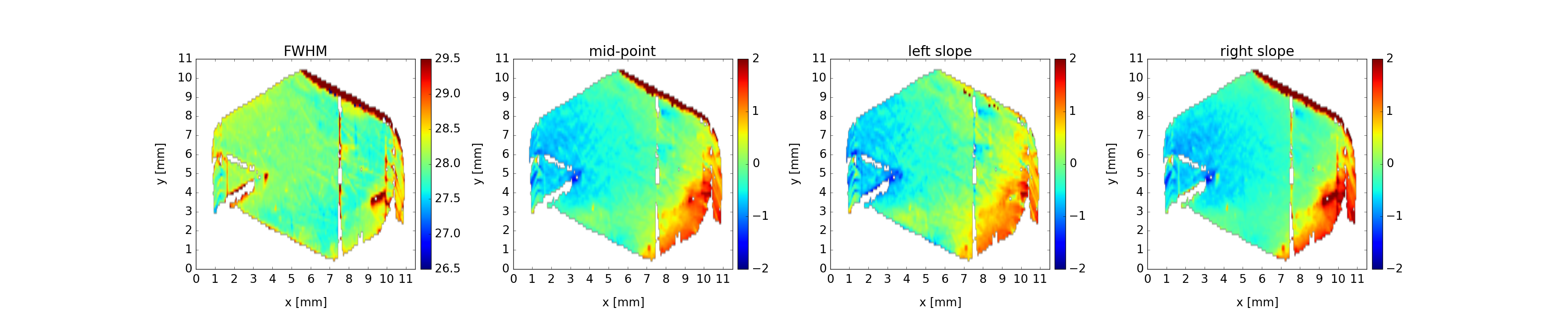
Fig. 3 Rocking curve topographs (selected and customized)
III. Sequential topography of forward diffraction data
The archive of data below represents a set of forward diffraction topographs of of a diamond (13 13 3) reflection in backscattering using a narrow bandwidth (1 meV) monochromatic x-rays. Instead of the Bragg angle of the crystal the photon energy of the incident x-ray beam (here in units of microradian) is scanned with small incremental steps.
C_TC.zip
The forward diffraction data are processed using an option -c. In this mode the normal transmission level is subtracted by the data, the resulting difference is then inverted and treated as a reflectivity curve. The data rejection threshold in this mode is specified in the ccd.py file with the parameter bkg0.
To process these data the rejection threshold represents the fraction of the normal transmission level and should be always less than 1.0 (-t 0.11 in this case):
rctopo -c -p -g -s -t 0.11 -r '0.2 1.3 0.25 0.45' -f 1.0 -i -u urad *h5
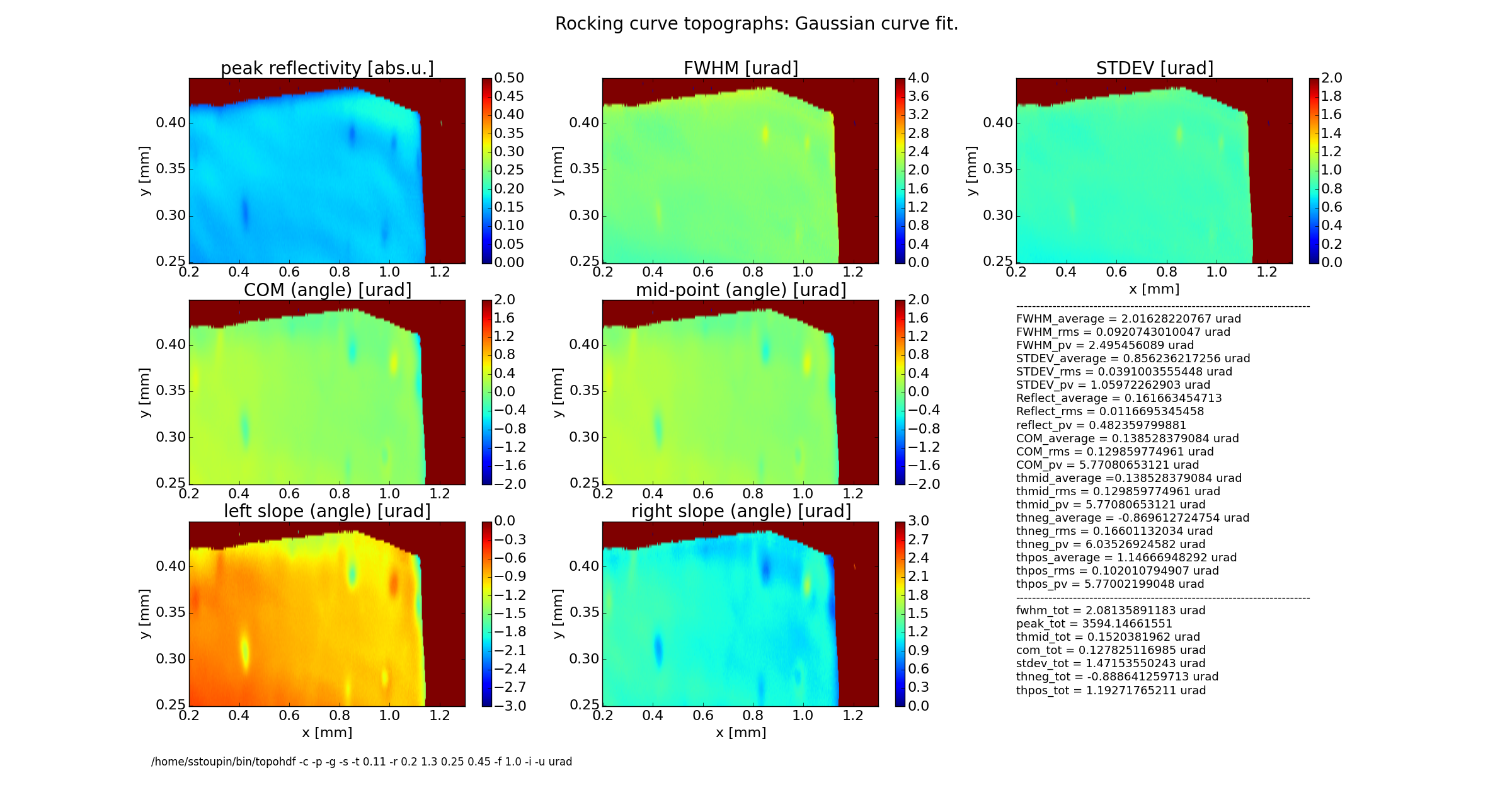
Fig. 1 Forward diffraction topographs
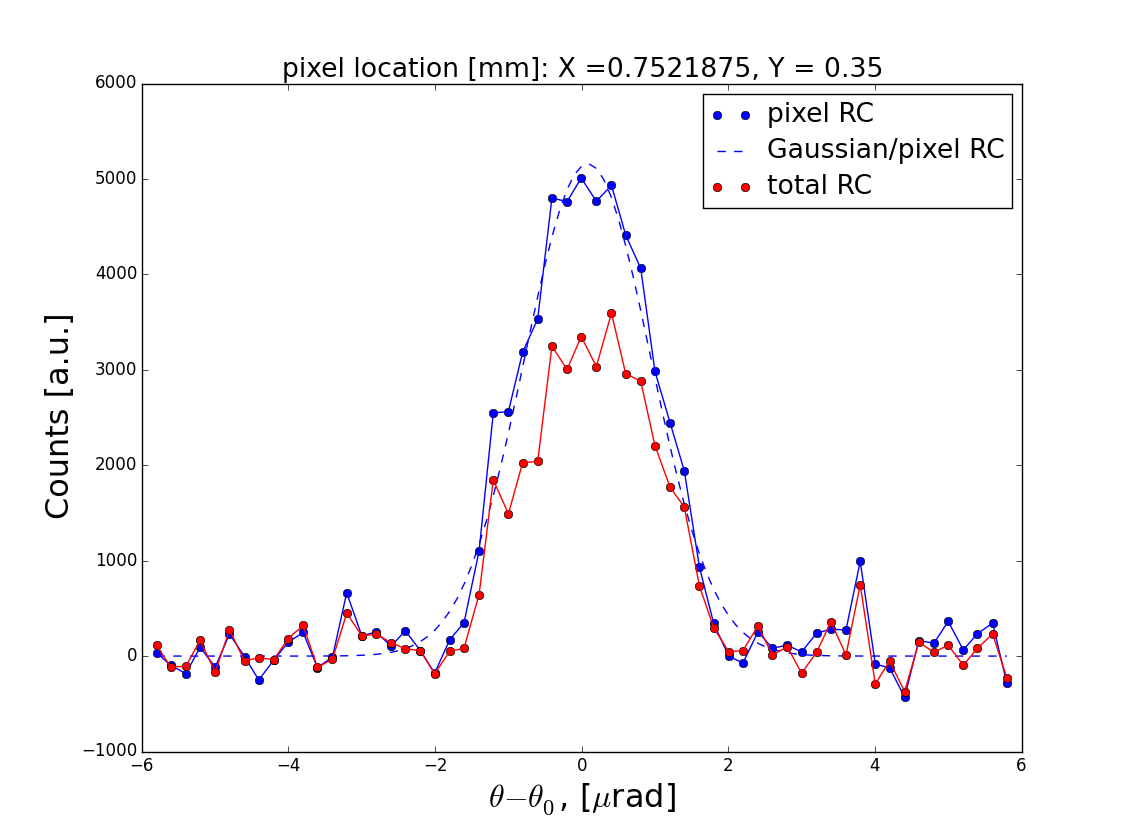
Fig. 2 Forward diffraction curves

Fig. 3 Forward diffraction topographs (selected and customized)